A Primary Like No Other
Why ITC Is Supporting Peggy Flanagan, Part 2

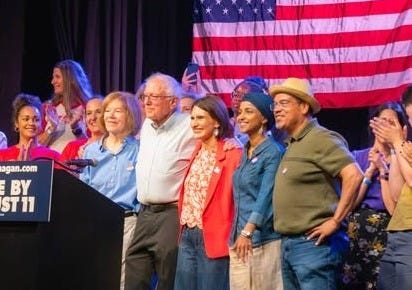
Two weeks ago, we shared why Indivisible Twin Cities is supporting Peggy Flanagan in her run for the U.S. Senate—highlighting her fighting spirit, her vision for improving people’s lives, and her refusal to be bought by billionaires and big corporations. “The Many Over the Money” is her mantra, and we are here for it.
This week we are going into more detail on some of the specific policy differences between Peggy Flanagan and her primary opponent, Angie Craig.
Indivisible Twin Cities describes the coming mid-terms as “An Election Like No Other.” And it’s true—nothing less than our democracy is likely at stake. Minnesota’s Democratic primary on August 11 is also a primary like no other, because the candidate Minnesota chooses—whether it be Angie Craig or Peggy Flanagan—will play an important role in determining the future of our democracy.
To many, the candidates may seem more alike than they are different. Both are liberal Democrats who share many of the same values. Both grew up in working-class families fighting to succeed. Flanagan is Native American, and Craig is a member of the LGBTQ community.
There are, however, significant contrasts as well, differences that might dictate what kind of Democratic party and country we could have in the future.
Indivisible Twin Cities is unequivocal in our support for Peggy Flanagan, and we encourage all Minnesotans to vote for her in the primary on August 11th.
Immigration and ICE
In January 2025, Angie Craig was one of 46 Democrats in the House to vote in favor of the Laken Riley Act, a punitive bill that allows for the detention without bail of undocumented immigrants who are accused of crimes (whether violent or nonviolent). Craig also voted for H.R. 488 last year, a resolution approved by the House of Representatives that “expresses gratitude to law enforcement officers, including U.S. Immigration and Customs Enforcement personnel, for protecting the homeland.”
Since then, Craig has publicly stated that she regrets her Laken Riley vote, saying, “Any bill that gives ICE new authority in this administration was the wrong decision.”
Peggy Flanagan’s positions on immigration are more sweeping, and she’s been able to channel Minnesotans’ anger and outrage about Metro Surge into powerful momentum for her campaign. At the No Kings rally at the Minnesota State Capitol in March 2026, she declared, “No matter what I do from here on out, I am fighting to avenge Minnesota.”
She has called for an end to Trump’s mass deportation policy, funding to repair the economic damages Metro Surge caused in Minnesota, investments in technology to maintain borders, a clear pathway to legal status for immigrants, dismantling ICE, and revising the immigration system.
The terror inflicted on our communities by federal agents will never be forgotten. When Trump ran for office, he promised a mass deportation of immigrants. A vote for the Laken-Riley Act was a vote in support of that promise.
Israel / Gaza
There is a major point of contention within the Democratic Party regarding support for Israel in light of the genocide occurring in Gaza and the West Bank. Flanagan has clarified her position on Israel; Craig’s candidate website is silent on Gaza and Israel.
In May 2024, Craig was one of 16 Democrats in the House who voted for the Israel Security Assistance Support Act to prevent the Biden administration from withholding military aid to Israel. And this month she was in the minority of Democrats who opposed Thomas Massie’s amendment to the State Department spending bill which would have eliminated $3.3 billion in funding for Israel.
Flanagan does not have a legislative record, but she has called for support for a ceasefire and a two-state solution for Palestine, a halt to offensive weapons sales to Israel, and aid to Gaza along with help in rebuilding the area.
Over the course of her career, Craig has accepted funds from AIPAC, a major supporter of the government of Israel. Craig says she no longer accepts money from the PAC; however, she does benefit from “overlapping donor networks, allied organizations and informal signals of support rather than explicit endorsements or direct spending,” and is still the only Democrat (along with four Republicans) from Minnesota that AIPAC recommends supporting.
A recent Star Tribune article notes that Flanagan met several times with AIPAC representatives, but Flanagan’s campaign says she never sought the group’s endorsement or financial support.
The atrocities that Bibi Netanyahu and his government have carried out on the Palestinian people need to stop, and it should not be controversial for a candidate running for office to say that out loud.
Cryptocurrency
The issue of cryptocurrency is important because it is tied so closely to corruption in politics. A bill being considered in the Senate right now, the CLARITY Act, is being sold to the American public as a law that will regulate crypto. In fact, it is actually favorable to the crypto industry. The U.S. House passed it in 2025. We need senators who will stand against it and support rigorous regulation of the crypto industry. Neither Flanagan nor Craig discusses crypto on their websites, but there are differences.
Craig has received a rating of “A” (strongly supports crypto) on the site Stand With Crypto. She voted for the GENIUS Act and the CLARITY Act as well as other pro-crypto bills and resolutions. She was the only House Democrat from Minnesota who voted for the CLARITY Act.
Flanagan has received a rating of “F” (strongly against crypto) on Stand With Crypto. The rating is based on two social media posts, one saying “This is Minnesota’s Senate seat. It doesn’t belong to giant corporations, crypto, or Big Oil. This is the people’s seat,” and another saying “Congress gave Trump the green light to start his own coin, and he’s created an $800 MILLION cryptocurrency scam. Trump is lining his own pockets while children go hungry and healthcare premiums skyrocket. It’s corrupt as hell.”
We talk to voters every day who are sick and tired of the corruption in Washington. We don’t need crypto-supporters representing us in the U.S. Senate.
Campaign Funding
With all the concern about corporations and billionaires buying elections, campaign funding is a significant issue. Both candidates say they will fight for campaign finance reform.
Craig’s campaign is supported by political action committees (PACs) that rely on “dark money,” meaning the organization is known but their donors are anonymous. Since first running for Congress, Craig has received funds from North Star Dawn, Minnesotans for Progress, and the Virginia-based Center Forward Committee. All these organizations are dark money groups or draw significant funds from dark money groups.
Craig has said that Democrats have to accept funding from corporations and anonymous wealthy donors because Republicans do. She does support campaign finance reforms that would restrict the role of money in politics. “But until we get to that day, it’s naive to think that we’re not going to need resources,” she has said.
Flanagan’s campaign has been supported mostly by small organizations, individuals, and PACs that are obligated to reveal their donors. One of the PACs supporting her is the Democratic Lieutenant Governor’s Association, which has received donations this election cycle from Meta, Lockheed Martin, pharmaceutical interests, teachers’ groups, and unions. When Flanagan headed the DLGA, it received a donation from CoreCivic, a private prison company that runs immigrant detention centers. Flanagan says she did not solicit that donation, and she asked that the funds be donated elsewhere.
“These outside groups aren’t spending millions of dollars to elect Congresswoman Craig to the Senate for no reason,” Flanagan said at a news conference. “They’re investing in someone who will do their bidding and attacking me because I won’t.”
Money in politics is a systemic issue that has broken our politics. We expect courageous leaders to fight against the status-quo, not just go along to get along.
Healthcare
Given the cuts that Republicans have made to healthcare and their impact on almost all Americans, this is an important issue. Both candidates support expanded access to health care and restoration of Medicare and Medicaid cuts.
Craig supports a public health insurance option rather than a single-payer plan. She resisted Republicans’ threats to gut Medicare, advocated for lower prescription drug prices for seniors, wrote the proposed bill that caps the cost of insulin for seniors, and wants to penalize drug companies for raising prices.
Flanagan has said health care is a human right and has clearly stated her support for a national, single-payer health care system similar to those in Canada and Europe. She has stated that requiring prior authorizations by insurance companies should be outlawed, that Medicaid and Medicare should cover vision, dental, and hearing care, and that mental health care should be expanded.
Americans are going bankrupt because of medical bills or dying because they can’t afford insurance. This crisis must be addressed head-on with systemic change rather than modest solutions.
Economic Support for Ordinary People
The candidates have similar positions on legislation and government programs that support working-class Americans. For instance, they both support the PRO Act, a proposed federal law giving unions and contract workers new legal protections.
In Congress, Craig has protected institutional programs like Social Security and Medicare from Republican attempts to cut them, and she voted against Trump’s cuts to SNAP. She has been consistently pro-labor, voting in favor of laws that protect workers and unions.
Flanagan supports substantive social changes and as lieutenant governor successfully fought for such laws at the state level. She fought to increase Minnesota’s minimum wage, tying it to inflation, and wants to do the same on the federal level. She was a leader in establishing Minnesota’s paid family and medical leave act—which made our state one of only 15 states and cities nationally that have such a law—and has promised to do the same in the Senate.
Government CAN make life better for ordinary people. It’s easy to be cynical and expect very little from politicians, but we need to support those who have bold visions and the ability to carry them out.
These differences between the Democratic senate candidates are why Indivisible Twin Cities has endorsed Flanagan—its first ever public endorsement—and why we have focused much of our energy supporting her campaign. She is the person we want to represent Minnesota in the Senate: someone who knows that substantive change is possible through people-powered movements, not billionaires and corporations, and who embodies a true activist spirit. We want more than the status quo in Congress. We want people like Flanagan who will work to fundamentally change the direction of this country.
CALL TO ACTION:
Talk to 10 friends about the election coming up. There is absolutely no substitute for talking to friends, family, and neighbors. Your voice has more influence within your circle than you can possibly know.
Encourage them to vote in the primary on August 11, or vote early, and make sure you vote yourself. To find out where to vote, or to request an absentee ballot to vote by mail, go to https://sos.mn.gov.
This primary is a turn-out election, but primaries have historically low turn-out. Let’s change that by turning out for a bold and substantive vision this time around!!
An excellent article. I would add that Rep. Craig voted, totally gratuitously, for the GOP anti-Mamdani resolution the day after his election as mayor of NYC.
A fair and informed accounting of the two candidates. I would add that Craig didn’t just vote for the Clarity Act. She is a co-sponsor. Her support for an “industry” that is really just a Ponzi scheme, and her willingness to vote for and then for months to defend her vote for Lakin Reilly show poor judgement. That is why I will vote for Peggy.