
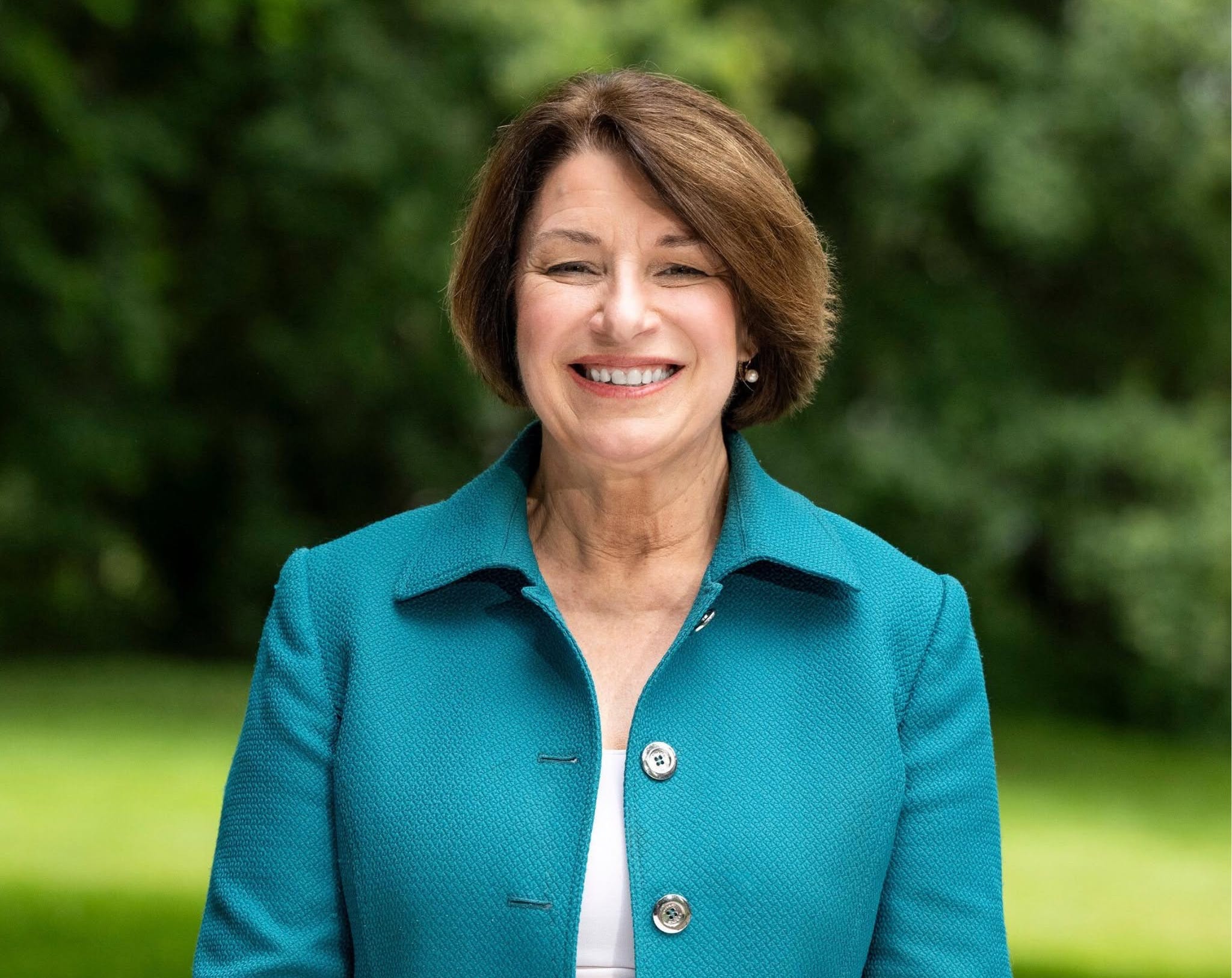
Photo Source: Facebook - Amy Klobuchar
With midterm elections only weeks away, Minnesotans must decide soon whom to choose for governor. Amy Klobuchar currently represents Minnesota in the U.S. Senate, having served in that position nearly twenty years. Lisa Demuth is Speaker of the Minnesota House of Representatives and has served in the House for seven years. Whoever wins will become the first female governor for the State of Minnesota.
A comparison of their records and proposals demonstrates that Amy Klobuchar is the governor Minnesota deserves. In this Election Like No Other, Indivisible Twin Cities endorses Klobuchar for governor.
Background and Experience
Amy Klobuchar is serving her fourth term in the U.S. Senate. She serves on numerous committees, including Judiciary; Rules and Administration; and Agriculture, Nutrition, and Forestry. Prior to the Senate, Klobuchar served eight years as Hennepin County Attorney and was president of the Minnesota County Attorneys Association. Before that, she worked as an attorney in private practice. In college, she interned for Vice President Walter Mondale, a stint that led to a decades-long bond between the two.
Lisa Demuth has been a member of the Minnesota House of Representatives since 2019. In 2025, she was the first African-American to become Speaker in a closely divided House. She’s served on House committees on Rules and Legislative Administration; Education Finance; Health Finance and Policy; and Early Childhood Finance and Policy. Before serving in the legislature, Demuth co-owned and managed commercial property with her husband. She was elected to the ROCORI School Board in 2007 and was reelected twice.
Affordability
Minnesotans are just as worried about high costs as other Americans. Robert Reich predicts that affordability will be the most important issue for voters in the midterms, and our two gubernatorial candidates seem to agree. Klobuchar says that as governor she will “work to lower costs that have been going through the roof across the country.” Demuth says affordability is her “number one issue.”
The two candidates do not agree, however, on the framing of or solutions to the problem. Demuth discusses high costs the way Republicans have for years: as a problem of high taxes and too much government regulation. Klobuchar attacks affordability holistically, as being caused by a cluster of related problems. The candidates’ differences in three areas illuminate their differences on affordability.
Health Care
As Minnesotans begin to feel the effects of the Big Ugly Bill on their health care costs, the candidates’ stances on health care become even more important.
Klobuchar voted for the Affordable Care Act (also known as Obamacare) and voted against cuts to its provisions in Trump’s Big Ugly Bill, pointing out that the cuts will kick millions of people off their health insurance and close more than 300 rural hospitals and 500 nursing homes. She supported a bill allowing Medicare to negotiate drug prices. As governor, she plans to work toward lowering the price of prescription drugs, saying she’ll “build on her years of fighting— […] beating Big Pharma to lower prescription drug prices for Minnesotans.” Her health care plan lowers costs, protects access to care, and supports medical innovation and the health care workforce.
On her campaign web site, Demuth doesn’t mention health care, though elsewhere she has criticized the ACA and supported the Big Ugly Bill, in particular the work requirement for Medicaid recipients. As Speaker, she did pass a bill to bail out Minnesota’s safety net hospital but opposed raising taxes to do so. She and other Republicans in the House killed a bill to utilize the federal 340B drug pricing protection program to allow hospitals treating low income patients to get discounts on drugs. She told the Committee to Protect Health Care, a group of Minnesota medical professionals, that her health care plan will increase competition, root out fraud, and support rural hospitals (though the Big Ugly Bill decimates rural hospitals).
Tariffs
Trump’s illegal tariffs have cost Minnesotans $4.8 billion since January 2025. Demuth doesn’t mention high costs associated with tariffs on her campaign web site, but elsewhere has said tariffs have a purpose. She has also said she would work closely with Trump.
Klobuchar says that Minnesota needs a governor who will stand up against federal policies that hurt Minnesotans, including tariffs. She voted against Trump’s tariffs numerous times before they were declared illegal by the Supreme Court. She has also joined with others to introduce a bill to end Trump’s new illegal tariffs against Canada, which is Minnesota’s biggest trading partner. Demuth has acknowledged that talks should restart with Canada.
It is worth mentioning the toll that both tariffs and the Iran War have taken on Minnesota’s farmers, with Trump’s policies making farm equipment more expensive, hurting agricultural exports, and increasing the cost of diesel and fertilizer. Klobuchar recognizes this cost—which some have called a “Farmageddon”—and plans to address it as governor by expanding the rural and agricultural economy, finding new markets for farm goods, providing and storing fertilizer locally, and expanding world markets. Demuth focuses on less regulation, as though regulation, not Trump policies, has caused the crisis for farmers and rural communities.
Housing
With high interest rates related to Trump’s runaway inflation, and high building costs due to tariffs, housing has become an important part of the affordability crisis.
As senator, Klobuchar addressed the high cost of housing by voting for the 21st Century ROAD to Housing Act, a bill that passed Congress without Trump’s signature. This law is designed to increase America’s housing supply, lower costs for families, and restrict large corporate investors from buying single-family homes. As governor, she plans to build 100,000 new units by the end of her first term, with a focus on manufactured and modular homes; address increased land prices caused by institutional investors (like hedge funds); and ban price-fixing algorithms, which companies use to coordinate rents.
Demuth proposes cutting regulations on builders, reducing property taxes, and limiting paid family leave (claiming that paid family leave is a tax on builders who then pass the cost on to home buyers).
Operation Metro Surge
Klobuchar praised Minnesota’s response to ICE during Operation Metro Surge, suggesting that resistance has made Minnesota a beacon of hope, a place where people want to live and open businesses.
Demuth blames Democrats for Operation Metro Surge, saying, “My concern was more the response and the concern that I had over local high-level elected officials and even people in the Legislature and the rhetoric that they were using.” She blocked two bills that would have provided $100 million in loans to businesses that lost revenue as a result of Operation Metro Surge, would have required federal agents to obtain warrants and not wear masks, and would have paved the way for citizens to sue federal officials. She’s proposed a bill to establish a new criminal offense called residential protesting, making it illegal to protest near a person’s house.
Klobuchar supports a pathway to legal immigration. As Senator, she voted “no” on the Laken Riley Act, which requires the detention of non-citizens who are arrested or charged with a crime, as opposed to actually convicted, and she called for an end to Metro Surge after Renee Good and Alex Pretti were murdered by ICE agents. When the Senate was considering funding ICE, she said the $70 billion might be better used to extend ACA premium tax credits for millions of Americans for two years; cover a full year of dental, vision, and hearing care for every senior on Medicare; or pay for 200,000 local police officers for three years.
Demuth has not criticized the murders of Renee Good and Alex Pretti, instead praising Trump for making our cities stronger. In response to a question about the federal surveillance of labor unions and progressive groups during Operation Metro Surge, she said that her focus is on fraud.
Fraud
Trump and Republicans have fixated on fraud because their policies have failed Americans. Demuth has followed their lead, making fraud a focus of her campaign in order to politicize the issue against Democrats. One problem with this approach is that Senator Klobuchar’s responsibility has been national, not state, legislation and oversight. When Demuth claims there is a “culture of fraud” in Minnesota’s state government, she’s criticizing a body that she has helped lead for seven years.
According to several sources, fraud in Minnesota is a result of years of expansion of social services without building state capacity for oversight of these programs. Over time, the state’s ability to regulate its social programs has been “hollowed out from within.” Since the Minnesota legislature writes the laws creating Medicaid programs, decides Department of Health Services spending, and develops tools for overseeing state programs, the House might have done something over the years to prevent the kind of fraud that is now the focus of Republican attacks against Democrats.
In 2026, in a bipartisan effort, the legislature created the Office of Inspector General. But other measures, such as background checks and institutional guardrails against fraud, have been difficult to pass because Republicans are prioritizing reduced government, privatization, and the contracting out of services.
Demuth’s Fraud Prevention Plan includes firing all agency heads and deputy commissioners, banning the transfer of public dollars to foreign countries, and recouping more money through restitution. Her plan emphasizes the role of state government employees in failing to prevent fraud; she wants to “demand accountability from state workers responsible for managing the state programs.” Not only is this reminiscent of the disastrous claims made and actions taken by DOGE, but DFL Chair Richard Carlbom calls her plan “empty political rhetoric.” The Minneapolis Times criticizes the plan for focusing on prosecuting individual wrongdoers and eliminating specific programs, when the ideal solution would be rebuilding the system.
Klobuchar’s proposal, on the other hand, has been called “a comprehensive plan to root out fraud” by a former U.S. attorney who prosecuted the Feeding Our Future fraud cases. Her plan does address the need for institutional changes and calls for an audit of state government, a “do not pay” database for providers connected to fraud, and creation of anti-fraud units in all state agencies.
As Senator, Klobuchar has a record of fighting fraud. She was co-sponsor of the Fraud Enforcement and Recovery Act that gave law enforcement greater resources to root out and prosecute financial crimes like mortgage fraud and Ponzi schemes. She voted against the GENIUS Act and helped prevent the Senate from voting on the CLARITY Act, both of which would have enabled crypto fraud. And when fraud was discovered in the Feeding Our Family cases, she pushed the DOJ to send more prosecutors to the U.S. Attorney’s office in Minnesota.
Guns
Minnesotans experienced 549 gun deaths last year. Two of those deaths were Melissa Hortman and her husband, murdered by an armed intruder. Another two were children killed in the Church of the Annunciation shooting, which also injured seventeen.
After the shootings at Annunciation, Demuth met with parents and told them she would not block a bill banning assault weapons and high capacity magazines. But then, after the bill passed the Minnesota Senate, Demuth refused to bring it to the floor of the House for a vote, saying that Republicans likely would have not allowed the bill’s passage. Demuth has received an A+ from the Minnesota Gun Owners Caucus, which also endorses her for governor.
On her Senate website, Klobuchar supports passing common sense gun safety legislation, banning assault weapons, improving background checks, and closing loopholes that allow suspected terrorists to buy firearms. She has co-sponsored legislation to ban assault weapons and bump stocks. Her support for gun control has earned her an “F” from both the NRA Political Victory Fund and the Minnesota Gun Owners Caucus.
Fighting for Minnesotans, Not MAGA
Klobuchar’s campaign criticizes Demuth for being unable to name one area of disagreement with Trump—even after his disastrous health care cuts, tariffs, ICE surge, and Iran War. Demuth and Trump do seem to be on the same page, with Demuth herself saying that she “fights and wins for the MAGA agenda.”
Minnesota needs a governor who will stand up for Minnesotans, even if that means fighting the federal government, which is what Klobuchar has vowed to do. Indivisible Twin Cities endorses Amy Klobuchar for Governor of Minnesota.
Call to Action:
Early voting by mail and in-person absentee begins September 18. Early in-person voting starts October 16. Election Day is November 3. We urge you to vote early to ensure your vote for Klobuchar counts in this election like no other.
You can help elect Amy Klobuchar and the rest of the slate of DFL candidates endorsed by ITC by volunteering for ITC’s campaign events: click here.
Nothing about how cozy Amy is with Netanyahu or all the AIPAC money she has taken. How unfair her policies have been to people of color.
I get it we have to vote for this blue wave. I am going to be over here looking for a better tomorrow with more progressive candidates.
Thanks for laying out the differences. Demuth is a lightweight compared to Klobuchar. And, I think she was the person who contacted the right wing influencer (forget his name) to make a video of the child care center. That put us even more on Trump’s radar and resulted in the occupation.